


-
WFL

-
1974 Season
-
1975 Season
-
Multimedia



WFL Fast Facts
- Gary L. Davidson initiated discussions on a proposed professional football league on August 2, 1973 that would eventually encompass the entire world.
- It was reported on October 2, 1973 that the World Football League was in operation and would start play in July, 1974.
- Jim Seymour was the first WFL player signed. He was offered a contract with the Chicago Fire on January 8, 1974.
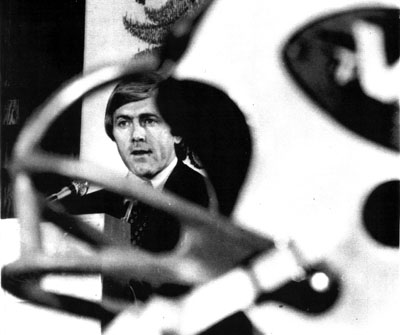
- The World Football League held the first league meeting in Los Angeles, California on January 14, 1974 with representatives from the following areas: Birmingham, Boston, Chicago, Detroit, Florida, Honolulu, Memphis, New York, Philadelphia, Southern California, Toronto, and Washington D.C. WFL Commissioner Gary L. Davidson presided over this meeting where he announced that the league would kickoff in July with six rules dramatically different from the National Football League.

- The World Football League held their first collegiate draft on January 22, 1974 and QB David Jaynes of Kansas was selected by Memphis (later Houston).

- The World Football League held their first professional player draft on March 18, 1974 with the Washington Ambassadors (later Florida Blazers) selecting RB Charlie Evans from the New York Giants.

- On April 4, 1974 the World Football League and the TVS Network sign a contract that guarantees the WFL a nationally televised Game of the Week.

- The April 15, 1974 cover of Sports Illustrated was scheduled to showcase WFL Commissioner Gary L. Davidson along with NFL All-Pro's Calvin Hill and Ted Kwalick. Both players had recently signed a future contract to play for the Hawaiians in 1975. The WFL cover was bumped for the Atlanta Braves' Hank Aaron who broke Babe Ruth's all-time record of 714 home runs. Click here to view.

- The WFL signed a contract with the World Sports Broadcast Network to form the World Football League Radio Network. In 1974 the network started with just 29 stations, but expanded to 118 by seasons end. The announcers were Frank Buetel on play by play, and Paul Flatley was the color commentator. During the 1975 season the network again had Frank Buetel and Jim Peterson as the color commentator. The World Football League Radio Network carried a Game of the Week both seasons. The network was carried by 125 stations in 1975.
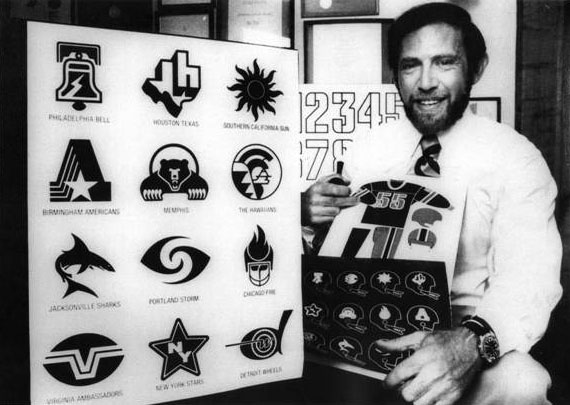
- The logos of each WFL team were created or coordinated by Ray Engle Associates of Los Angeles to project a corporate image. The team uniforms, coaches attire and officials uniform were designed by the Sand Knit company of Wisconsin.
- Did you know that the bill, designed to keep the WFL out of Canada, specifically Toronto, was table by health minister, Marc Lalonde? The bill, designed specifically to stop the Toronto Northmen entitled the "Canadian Football Act," was tabled on April 10, 1974 and passed in principle by April 26, 1974.
- Did you know that it was a New York system analyst who invented the "Action Point?" That man was Bill Finneran. He would also propose to the WFL in 1975 the color coded pants.
- Did you know that the WFL used a device to make yard measurements easier? In 1974, the WFL introduced a device called a "Dicker Rod," a device which was three yards in length. One end would be placed on a five yard line and a movable marker would then be moved to the position of the first down, thus only one official need run out onto the field for a measurement.
- Jane Chastain becomes the first female to broadcast a pro football game on national television. Chastain was in the broadcast booth for the TVS Sports Network along with Merle Harmon and Alex Hawkins as their "guest" commentator for the New York Stars-Philadelphia Bell WFL game on July 25, 1974. She later broadcasted an NFL game, October 13, 1974, on the CBS Network alongside Don Criqui and Irv Cross. This was another first for the World Football League.
- Did you know that when the Detroit Wheels folded, its players were selected by other teams in a four round, special selection process conducted by the league? This draft is known as a dispersal draft.
- Did you know the WFL had its own player association? Formed in late September of 1974, the WFLPA had the following officers: Charlie Harraway of the Birmingham Americans as President. John Huarte of the Memphis Southmen was named first Vice-President and Ike Lassiter of the Jacksonville Sharks was second Vice-President. Jon Henderson of the Detroit Wheels was the Secretary and Joe Robb of the Shreveport Steamer was the Treasurer. The WFLPA appointed Alan R. Miller as its legal counsel. Some of the player reps were Bob Davis, Florida, Virgil Carter, Chicago, Dave Williams, Southern California, Sam Silas, Portland, John Elliott, New York, and Claude Watts of Philadelphia.
- When the financially troubled Portland Storm headed to Honolulu to play the Hawaiians, the team was fed with $2500.00 of meal money collected by local Portland citizens. A much moved Portland coach Dick Coury said, "It"s beautiful for the people of Portland to do something like that. It"s amazing." During the game, however, the Storm players didn"t stay around for the final gun. When Honolulu scored a late touchdown to make to make it 23-0, the Portland players stalked off the field and headed for the showers with two seconds to go in the game.
- At a league summit on November 22, 1974 in Memphis to discuss the next season of the WFL, dubbed "WFL 75," several new cities were mentioned as having investors ready to begin play in 1975. San Antonio, Louisville, Tulsa, Akron, Connecticut, Syracuse, Phoenix, Montreal and Toronto were named. Paul Hornung, former Green Bay Packers star was reportedly interested in a franchise in Louisville, KY. Chris Hemmeter assumed the role of Commissioner at this meeting.
- During the "WFL 75" meeting, Bob Wussler - CBS Vice President in charge of sports told WFL officials in Memphis that his network would carry WFL games beginning in 1976 if the new league can prove credibility during the 1975 season.
- Everyone knows the Chicago Fire forfeited their final game against Philadelphia. In Fire owner Tom Origer"s words, he called the game "meaningless."
- Larry King, formerly of CNN fame, was a color commentator for the Shreveport Steamer broadcast team in 1974 on KWKH - 1130 AM radio.
- Did you know the original 1974 WFL playoff format was supposed to have as many as eight teams? The format was revised three times during two days before the playoffs started (November 21). It started at four teams, then went to the aforementioned eight, then went to as low as three teams (division teams), then to four (division winners plus wild card), then finally at six.
- The World Football League held World Bowl I at Legion Field in Birmingham, Alabama on December 5, 1974. The Birmingham Americans defeated the Florida Blazers 22-21. The Americans who would have their uniforms confiscated after the game by the sheriff's department were slated to be paid $1400.00 for each winning player. The Blazers was supposed to receive $1000.00 for each player, but instead were paid only $400.00.
- Did you know the WFL tried to sign New York Jets QB Joe Namath in 1975? He was offered a three-year, $5 million deal to play for the Chicago Winds. The Winds color scheme was green and white as were the Jets. They also hired Babe Parilli as Head Coach. Parilli had been Namath"s backup during the Jets Super Bowl III victory.
- A "controlled scrimmage" game in July of 1975 between the Birmingham Vulcans and Memphis Southmen drew 35,000 fans with adults paying $3, and children under twelve years of age paying $1.
- Did you know that on July 29, 1975 former Green Bay Packers All-Pro safety Willie Wood became the first black head coach in pro football's modern history? He replaced interim head coach Joe Gardi prior to the season opener for the Philadelphia Bell. Wood had previously served as the Bell defensive coordinator under former head coach Ron Waller.

- The Charlotte Hornets were going to be showcased on NBC"s Grandstand show on October 26, 1975 as they were the only team in pro sports to have their entire roster paid on a percentage of revenues. Unfortunately, the WFL shut down operations on October 22, 1975 as NBC camera crews were rolling into Charlotte to start setting up for interviews.
- When the WFL officially folded on October 22, 1975, there was a proposal put forth of Birmingham, Memphis and Southern California immediately playing two games, one playoff and then World Bowl II, but that proposal was voted down.
- Reference has been made over the years that the World Football League crowned the Birmingham Vulcans as the 1975 league champions because they owned the best record (9-3) at the time the league shut down. This is not true. The league disbanded on October 22, 1975, and no team was ever named as the 1975 World Football League Champions.
- Did you know that the WFL had an all-star game planned? If the league saw the 1976 season, the game would have been held in Honolulu.
- Shortly after the World Football League folded, the Memphis Grizzlies and Birmingham Vulcans submitted their application to the NFL Expansion Committee in order to join the 28 teams - including expansionists Seattle and Tampa Bay for the 1976 NFL season. On December 17, 1975, the NFL Expansion Committee rejected both Memphis and Birmingham's applications. Memphis owner John Bassett made a request to NFL Commissioner Pete Rozelle to put his expansion application to a vote at the NFL owners meeting in March of 1976. Another vote, this time by the NFL owners, ended in rejection for the Grizzlies to be admitted into the NFL by a vote of 25-3.
- The music video "Money" by Pink Floyd has a brief clip of WFL footage. It is the Southern California Sun against the Houston Texans. This game was televised on the TVS Network on August 15, 1974. The TV show Hawaii 5-0 also had some WFL footage in their show. In season nine the show opens with color footage of the Philadelphia Bell playing the Hawaiians in the new Aloha stadium. The name of this episode is "Blood Money is Hard to Wash."
- John McVay, Jack Pardee, Marty Schottenheimer, Lindy Infante, Kay Stephenson, and Jim Fassel were all head coaches in the NFL. All of the above began their pro resume in the WFL as either a head coach, assistant coach, player/coach, or a player personnel director.
- Tom Fears, Willie Wood, Don Maynard, Larry Csonka, Paul Warfield, Herb Adderly, Leroy Kelly and Ron Mix are inductees of the Pro Football Hall of Fame and spent time in the World Football League as either a player or a coach. Mix was General Manager of the Portland Storm.
NOTE: WFL Fast Facts were compiled by Richie Franklin and Robert Phillips.
© Copyright 1996-2007 Robert Phillips, All Rights Reserved